

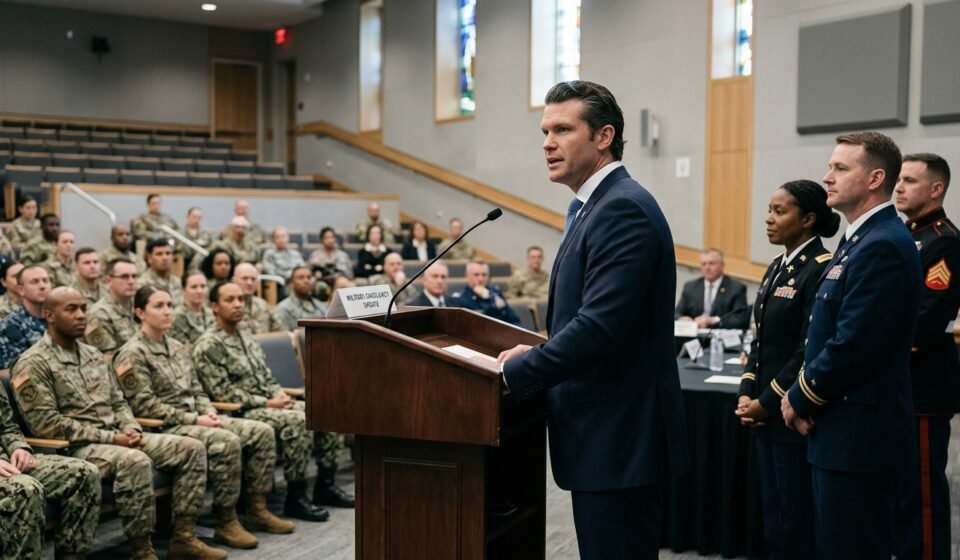

The search phrase pete hegseth chaplains now refers to a series of significant changes involving the U.S. military’s Chaplain Corps and the way religious support is organized across the armed forces. Since late 2025, Pete Hegseth has announced measures involving spiritual-readiness programs, religious affiliation records, chaplain uniforms, and, most recently, a new Office of Religious Affairs at the Pentagon.
As of October 3, 2026, the most recent development is the creation of that office after Hegseth’s September 30 “State of the Force” address at Marine Corps Base Quantico. The office is intended to advocate for chaplains and religious support while reporting directly to the secretary.
Understanding the issue requires separating several different changes that are sometimes grouped together. Some concern administrative records, others concern how chaplains appear in uniform, and the newest initiative concerns the organizational structure overseeing religious affairs.
Why Pete Hegseth Focused on the Chaplain Corps
Hegseth began publicly outlining his chaplaincy changes in December 2025. At that time, he criticized the Army Spiritual Fitness Guide and argued that the military’s chaplaincy had moved too far toward therapeutic and secular concepts.
He directed the Army to discontinue the existing guide and said spiritual well-being should be treated alongside physical and mental well-being. He also announced plans to simplify the military’s religious affiliation coding system. The Department of War later described these steps as part of a broader effort to strengthen the role of chaplains.
The original Army guide, published in 2025, had been presented by Army Chaplain Corps leadership as an operational resource focused on identity, purpose, meaning and spiritual readiness. It was intended to help leaders and soldiers address the spiritual dimension of military life.
This difference in emphasis is important. Hegseth’s public argument was that chaplains should be more clearly focused on religious ministry, while the earlier Army material had attempted to describe spiritual fitness in a broader framework that could apply to religious and nonreligious personnel.
The 31 Religious Affiliation Codes
One of the most visible changes involved the military’s system for recording religious affiliations.
In March 2026, Hegseth announced that the previous system of more than 200 faith and belief codes would be replaced by 31 standardized religious affiliation codes. He said the older system had become too complicated and that the reduced list would give chaplains more usable information for planning religious support.
The revised categories include major traditions such as Buddhism, Hinduism, Islam, Judaism, Sikhism and the Baha’i faith, along with multiple Christian affiliations. The list also includes categories for agnosticism, no religion and other religions. Some formerly separate designations, including Wiccan and certain Indigenous or smaller belief categories, are now represented through broader classifications rather than their own individual codes.
An important point that is sometimes missed in coverage is that these administrative codes do not create a legal list of religions that service members are allowed to practice. The Air Force has stated that religious preferences placed on identification tags are not restricted to the standardized administrative list.
The change is therefore primarily about military personnel records, demographic information and resource planning. Air Force officials have said the standardized system is intended to give chaplains more accurate information for allocating religious resources while maintaining religious freedom.
Chaplains Still Keep Their Military Rank
Another major part of the Hegseth reforms concerns uniforms.
In March 2026, Hegseth ordered military chaplains to replace visible rank insignia on their work uniforms with religious insignia. The chaplains did not lose their military rank. Instead, the change altered how that rank is displayed.
Hegseth explained the decision by emphasizing what he considered the chaplain’s primary identity as a religious leader. He also said the change could make junior service members more comfortable seeking advice from chaplains about sensitive matters.
The policy was subsequently implemented by individual military services. For example, Department of the Air Force guidance requires chaplains to use religious affiliation insignia on operational uniforms while continuing to wear rank insignia on service dress uniforms. Airmen and Guardians are still expected to treat chaplains as commissioned officers.
This distinction matters because a chaplain occupies an unusual position in the military. Chaplains are commissioned officers, but their professional function is religious support rather than command of combat units. The Armed Forces Chaplains Board describes its responsibilities as including religious freedom, chaplain procurement and training, professional standards, and policies concerning religious support.
What Military Chaplains Actually Do
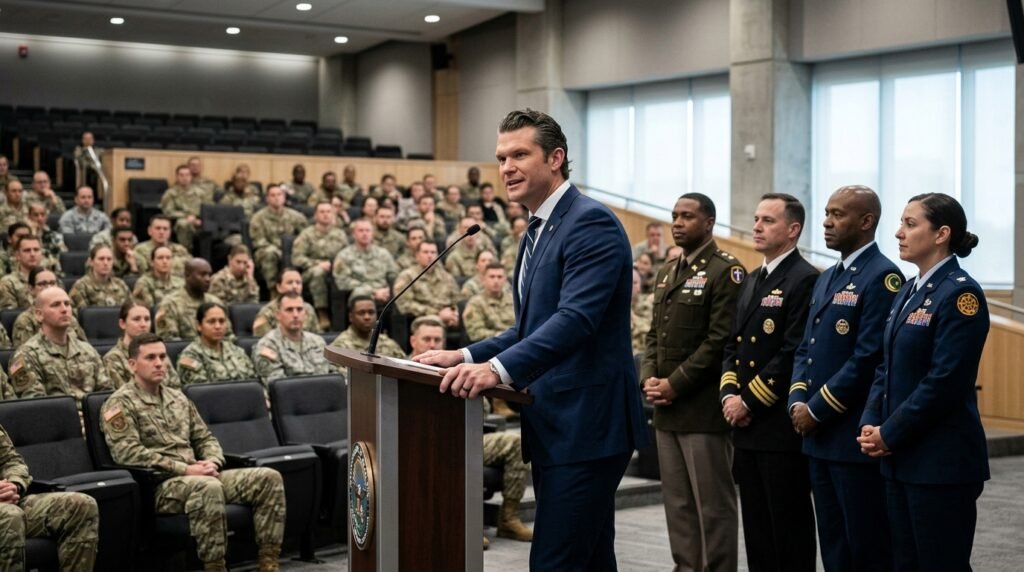
The Chaplain Corps is considerably broader than conducting worship services.
The U.S. Army says its Chaplain Corps provides religious support and advises military leaders on religion, ethics and morale. Chaplains can provide or coordinate worship, pastoral care and other religious services while helping commanders understand religious issues affecting military personnel.
The Army also explicitly describes chaplains as supporting the free exercise of religion. Its current chaplain resources state that chaplains advise commanders on protecting free-exercise rights, including for soldiers who do not hold a faith, and coordinate support when a chaplain cannot personally provide a particular religious service.
That mission helps explain why the Hegseth reforms have generated discussion beyond questions about Christian worship. Military chaplaincy has to function inside an institution containing people from many different religious traditions as well as people with no religious affiliation.
Pentagon Prayer Services Became Part of the Broader Debate
Hegseth’s chaplain policies have also occurred alongside a more visible role for Christian worship at the Pentagon.
In December 2025, Hegseth and his wife hosted a Christmas worship service featuring Rev. Franklin Graham and Christian musicians. The Department of War reported that regular prayer services were also being held at the Pentagon.
A DVIDS listing documents another Pentagon Christian prayer service hosted by Hegseth on April 15, 2026.
The services have become part of the wider discussion about how religious expression should operate inside a federal military institution. Reporting from the Associated Press notes that the Pentagon says participation is voluntary and that its religious initiatives should not favor one faith or reduce the rights of personnel of any faith or no faith. Religious-freedom advocates have disputed whether the broader approach achieves that neutrality.
Those are competing assessments, not the same claim. The Pentagon’s stated policy position and the criticism from outside organizations should therefore be understood separately.
The New Office of Religious Affairs
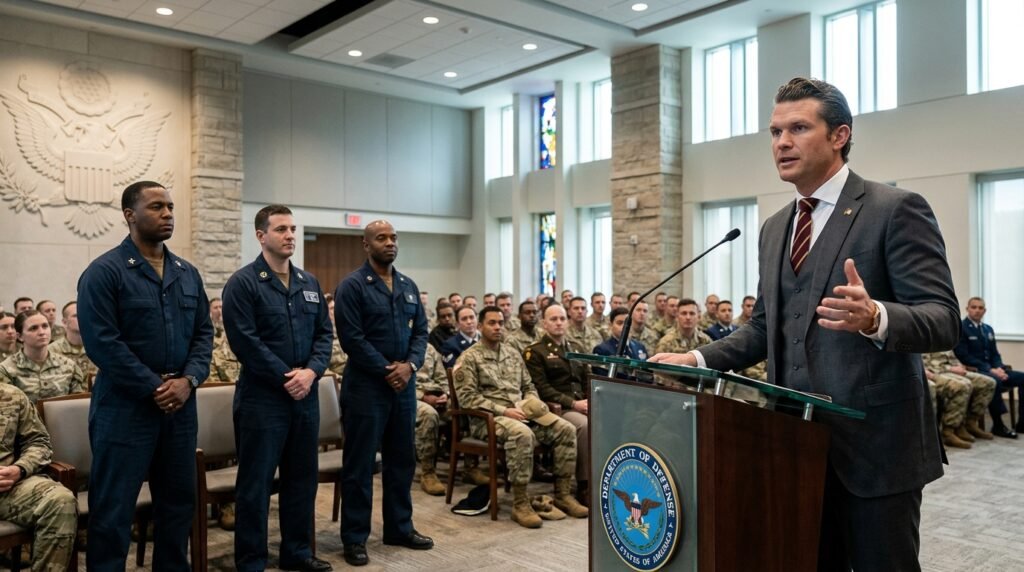
The newest development came on September 30, 2026, when Hegseth announced the creation of an Office of Religious Affairs, or ORA.
According to the Pentagon’s memorandum, the office will advocate for religious affairs and military chaplains at the highest level of the department. Its director will report directly to the secretary and deputy secretary rather than operating through an ordinary intermediate chain. The director had not been publicly named as of the latest reporting.
The office’s responsibilities are broader than simply organizing worship. The memorandum describes work involving funding, religious facilities, chaplain training, chaplain-led programs, chapel youth programs, faith-based support for military families, initiatives related to suicide reduction and research into spiritual fitness and spiritual readiness.
Hegseth presented the office as a way to give chaplains a more direct connection to senior leadership and to address what he views as bureaucratic barriers.
The Pentagon, meanwhile, explicitly stated that the office is not intended to compel religious participation, favor a particular faith or diminish the free-exercise rights of service members, civilian employees or military families.
Why the New Structure Has Drawn Questions
Supporters of the initiative can point to practical issues such as funding, facilities, training and ensuring that chaplains have adequate resources. The Roman Catholic Archdiocese for the Military Services, for example, welcomed the creation of the office and said placing spiritual readiness alongside other department priorities could help address longstanding resource limitations.
At the same time, some religious leaders have raised questions about how the new office will interact with existing chaplain leadership.
The Episcopal Church’s Armed Forces and Federal Ministries bishop, Ann Ritonia, told Religion News Service that the memorandum contained potentially useful provisions concerning resources but also questioned whether the direct structure could create confusion about the traditional chain of command and the role of the military services’ chiefs of chaplains.
Religious-freedom organizations have raised a different concern, arguing that Hegseth’s highly visible Christian initiatives could give Christianity a stronger role in military policy. The Pentagon rejects that interpretation and says the office will support personnel regardless of faith or nonbelief.
What Has Changed and What Has Not
Taken together, the reforms show several distinct changes.
The religious-record system has been reduced to 31 standardized categories, while service members retain broader freedom regarding religious identification on military identification tags.
Chaplains have begun removing visible rank insignia from certain operational uniforms, but they remain commissioned officers and continue to wear rank in designated formal uniforms.
The military’s existing Chaplain Corps also remains responsible for providing religious support and protecting free exercise. The creation of the Office of Religious Affairs does not eliminate the service-level chaplain organizations. Instead, the new office is designed to give religious affairs a more centralized presence at the department’s highest level.
The implementation is still developing. As of October 2, Air Force active-duty personnel were required to review their new religious affiliation records by October 16, while Air Force Reserve and Air National Guard personnel had a November 9 deadline. Stars and Stripes reported that the Army, Navy and Coast Guard had not yet published equivalent deadlines at that time.
Frequently Asked Questions
Did Pete Hegseth remove military chaplains from the officer corps?
No. Chaplains remain commissioned officers. The reform changes the display of rank on certain uniforms rather than eliminating their military rank.
Why were the religious affiliation codes reduced?
Hegseth said the previous system had grown to more than 200 codes and was too complicated to be useful. The department says the standardized system is intended to provide chaplains with clearer demographic information for religious-support planning.
Does the 31-code system prevent service members from practicing other religions?
The administrative list is not a limit on religious practice. Air Force guidance says service members are not restricted to the standardized choices when selecting a religious preference for identification tags.
What is the Office of Religious Affairs supposed to do?
The new office is intended to coordinate and advocate for religious support, chaplain programs, facilities, training, funding and spiritual-readiness initiatives. It reports directly to the secretary and deputy secretary.
Conclusion
The current pete hegseth chaplains story is not about one single policy. It is a developing overhaul of military religious support that began with Hegseth’s December 2025 criticism of the Army’s spiritual-fitness approach and expanded through changes to religious affiliation records, chaplain uniforms and Pentagon-level religious administration.
The most important development as of October 3, 2026, is the Office of Religious Affairs. Its creation gives religious affairs and chaplain support a direct connection to the Pentagon secretary, while the military continues to maintain chaplain organizations within the individual services.
The long-term significance of these changes will depend in part on how the new office operates, how the 31-code system is implemented across the services, and how military leaders balance religious ministry with the constitutional requirement to protect the free exercise of religion for service members of every faith and for those with no religious affiliation.