



Have you ever received a text message that simply says “nvm” and wondered whether the person is annoyed, has changed their mind, or no longer needs your help? This small abbreviation is common in everyday digital conversations, but its meaning can depend on the situation.
The good news is that understanding it is straightforward. In texting and online conversations, what does nvm mean in text has a simple answer: NVM usually stands for “never mind.” People use it when they want someone to disregard a previous message, stop worrying about a question, or move on because something is no longer important.
For example, imagine asking a friend where they put their headphones. Before your friend responds, you find them under your bed and send, “nvm, found them!” Your friend now knows that you no longer need an answer.
The abbreviation can also appear in social media messages, gaming chats, group conversations, and direct messages. However, understanding the basic definition is only the beginning. Knowing how NVM sounds in different situations can help you avoid unnecessary confusion and respond more naturally.
What Does NVM Mean in Text?
NVM is an informal abbreviation for “never mind.” Dictionary.com lists this as its texting-related meaning, while Merriam-Webster explains that “never mind” can tell someone to disregard a previously mentioned or asked-about subject.
Dictionary.com
+1
In everyday language, someone using NVM generally means one of the following:
- Forget what I just said.
- You do not need to answer my question anymore.
- I figured it out myself.
- I have changed my mind.
- It is not important anymore.
For instance, consider this conversation:
“Do you remember the Wi-Fi password?”
“Nvm, I found it written on the router.”
In this example, the sender has solved the problem independently. The other person does not need to search for the password.
NVM can also be a complete response or appear at the beginning of a longer message. Both “nvm” and “NVM” communicate the same basic meaning in ordinary texting.
The important thing to remember is that the abbreviation usually tells you to move past something previously mentioned. The reason for doing so depends on the surrounding conversation.
How People Use NVM in Everyday Conversations
People use NVM for several practical reasons. Although the abbreviation stays the same, its purpose may change depending on what happened earlier in the chat.
One common use is correcting a question that no longer needs an answer. Someone might ask for a location, check a website, and discover the information independently. Sending NVM saves the other person from responding unnecessarily.
Another use is withdrawing a request. For example, someone might ask you to bring a charger and then realize they already have one. A message such as “nvm, I have an extra charger” communicates that the request has been canceled.
People also use NVM when they decide to stop discussing something. A person might begin explaining a minor problem but then conclude that it is not worth the time or effort. In that situation, the abbreviation signals that they would prefer to leave the subject alone.
Finally, NVM can help someone correct a message. If a person sends an incorrect detail, misunderstands a question, or messages the wrong group, they might follow up with “nvm, wrong chat” or “nvm, I read that wrong.”
These uses share the same central idea: the earlier message no longer requires the same attention.
Examples of NVM in Text Messages
Seeing NVM in realistic conversations makes the meaning easier to understand. Here are several original examples of how people might use it.
Example 1: Finding an answer
Person A: “What time does the movie start?”
Person B: “I think it’s at seven.”
Person A: “Nvm, I just checked the ticket. It starts at 7:30.”
Here, NVM tells the other person that the original information has been checked and corrected.
Example 2: Changing a request
Person A: “Can you send me your notes from class?”
Person B: “Sure, give me a minute.”
Person A: “Nvm, my classmate just sent them.”
The sender no longer needs the notes, so the request is withdrawn.
Example 3: Dropping a topic
Person A: “I wanted to ask you something about yesterday.”
Person B: “What happened?”
Person A: “Nvm, it can wait until tomorrow.”
This message means the sender has decided not to continue the conversation right now.
Example 4: Correcting a mistake
Person A: “Are we meeting on Thursday?”
Person B: “Yes, Thursday.”
Person A: “Nvm, I meant Friday.”
The sender uses NVM while correcting their earlier message.
Example 5: A casual conversation
Person A: “Did you see my new profile picture?”
Person B: “Not yet.”
Person A: “Nvm lol, I changed it again.”
Adding “lol” makes the message sound more lighthearted in this particular example.
These examples show why the surrounding words matter. NVM can resolve a simple misunderstanding, cancel an unnecessary request, or bring a conversation to a temporary stop.
SlangDecoded
+1
Does NVM Mean Someone Is Angry or Being Rude?
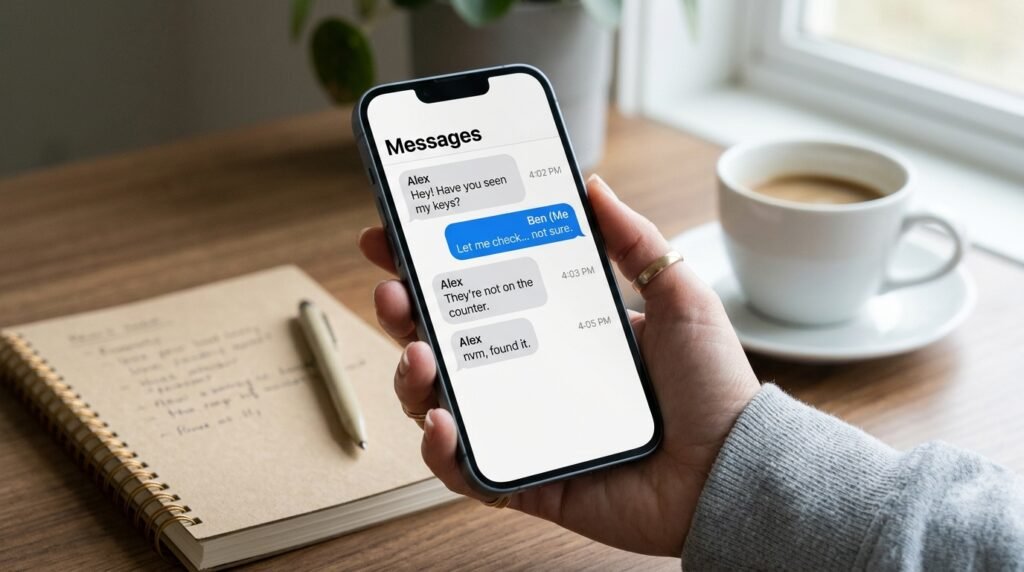
Not necessarily. Receiving NVM does not automatically mean that someone is angry, upset, disappointed, or ignoring you.
When a person writes “nvm, I found it,” the meaning is usually clear and practical. They have found what they were looking for and no longer need help.
However, a message containing only “nvm” can sometimes feel abrupt. This is especially possible during a disagreement or when someone has been waiting for a response to an important question.
Consider the difference between these messages:
“Nvm, I figured it out!”
“Nvm. Forget it.”
Both contain the same abbreviation, but the additional words create different impressions. The first sounds helpful and relaxed, while the second may suggest frustration depending on the conversation.
Capitalization and punctuation can influence how a message is perceived, but neither proves the sender’s emotional state. People have different texting habits, and some routinely send short messages without intending to sound unfriendly.
Therefore, avoid assuming the worst based on three letters alone. Consider what the person said earlier, your relationship with them, and the overall tone of the conversation.
If the message seems unusual or important, a simple question can clear things up without creating unnecessary tension.
How Should You Reply When Someone Texts NVM?
Your response should depend on whether the original issue has been resolved and whether the conversation needs to continue.
If someone says, “Nvm, I found it,” an easy reply is “Okay, no worries!” This acknowledges their message without making a simple situation complicated.
If someone withdraws a request, you could respond with “All good” or “Sure, just let me know if you need anything else.” Both options are friendly and leave the door open for further communication.
If someone sends a bare NVM after asking an important question, you might say, “Okay, did you still want to talk about it?” This gives them an opportunity to explain without pressuring them.
When the person appears upset, a calmer response is often better than immediately asking why they are being rude. For example, “No pressure, but I’m here if you want to talk” allows them to continue when they feel comfortable.
You do not need to respond to every NVM with a long explanation. In many conversations, a brief acknowledgment is enough. The goal is to understand whether anything still requires your attention.
What Is the Difference Between NVM and NM?
NVM and NM look similar, but their meanings are not always identical.
NVM usually means “never mind.” It commonly tells someone to disregard a previous message, question, or request.
NM can mean “not much” in casual conversations, although it can also mean “never mind” depending on context. Dictionary.com recognizes both texting-related interpretations for NM.
Dictionary.com
For example:
Person A: “Hey, what’s up?”
Person B: “NM, just relaxing. You?”
Here, NM means “not much.”
Now consider a different exchange:
Person A: “Can you tell me the answer?”
Person B: “NM, I figured it out.”
In this second example, the sender is using NM as a shortened form of “never mind.”
The easiest way to distinguish them is to read the entire conversation. If someone is answering a question about what they are doing, NM may mean “not much.” If they are canceling a request or telling you to disregard something, it may mean “never mind.”
Is NVM Appropriate in Professional Messages?
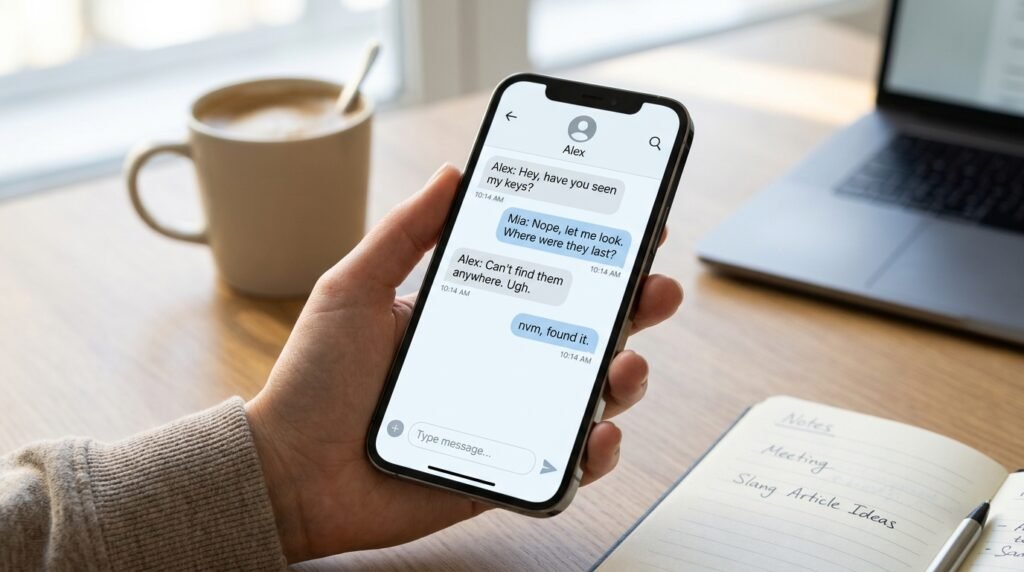
NVM is generally suitable for informal communication with friends, family members, classmates, and people you know well. It fits the quick, conversational style of text messages and social media chats.
However, it may be less appropriate in formal emails, official business correspondence, or messages to someone who expects professional language.
For example, instead of writing:
“NVM, I got the information.”
You could write:
“Please disregard my previous message. I have found the information I needed.”
Alternatively, you might say, “I found the answer, thank you for your help.”
These alternatives communicate the same basic idea while sounding clearer and more professional. They are particularly useful when communicating with clients, managers, teachers, or unfamiliar contacts.
The decision is not simply about whether an abbreviation is correct. It is about matching your language to the audience and the purpose of the conversation.
Can NVM Have Another Meaning?
Yes. Although “never mind” is the usual interpretation in text messages, NVM can stand for different terms in specialized settings.
For example, in computing, NVM can mean “non-volatile memory.” Dictionary.com lists this as a technical meaning distinct from its informal texting definition.
Dictionary.com
Non-volatile memory refers to memory that retains stored information even when electrical power is removed. The term may appear in discussions about computer hardware, storage, and related technologies.
However, you generally do not need to interpret an ordinary message from a friend as a technical reference. The surrounding context provides the most useful clue.
If NVM appears in a casual chat following a question, it almost certainly means “never mind.” If it appears in a technical article about computer hardware, the intended meaning may be different.
Frequently Asked Questions About NVM
What does NVM mean from a girl or a guy?
NVM has the same basic meaning regardless of whether the sender is a girl or a guy. It usually stands for “never mind.” The person’s intended tone depends on the conversation rather than their gender.
What does NVM mean after a question?
When someone sends NVM after asking a question, they usually mean that they no longer need an answer. They may have found the information themselves, changed their mind, or decided that the question is no longer important.
Does NVM mean “not very much”?
Usually, no. NVM normally means “never mind” in texting. NM, without the V, is often used for “not much,” although context can affect its meaning.
Is NVM the same as “forget it”?
In many texting situations, yes. Both expressions can tell someone to disregard something previously mentioned. However, “forget it” can sometimes sound more frustrated or dismissive, so the surrounding conversation matters.
Should I be worried if someone texts only NVM?
Not automatically. They may have solved a problem, changed their mind, or decided to drop a topic. If the message follows an argument or a sensitive discussion, asking a calm follow-up question may help you understand what they intended.
Conclusion
Understanding what does nvm mean in text is simple once you know its most common definition. NVM stands for “never mind” and is used when someone wants to withdraw a question, cancel a request, correct a message, or move on from something that no longer matters.
The abbreviation is common in casual texting, social media conversations, and online chats. It can sound friendly, neutral, or abrupt depending on the words around it, so it is best not to assume that someone is angry simply because they use NVM.
When you receive the abbreviation, read the conversation as a whole. A quick “no worries” may be all that is needed, while an important or confusing exchange may deserve a polite follow-up.
Ultimately, NVM is a small piece of texting shorthand with a straightforward purpose: letting someone know that the previous message no longer needs attention.