

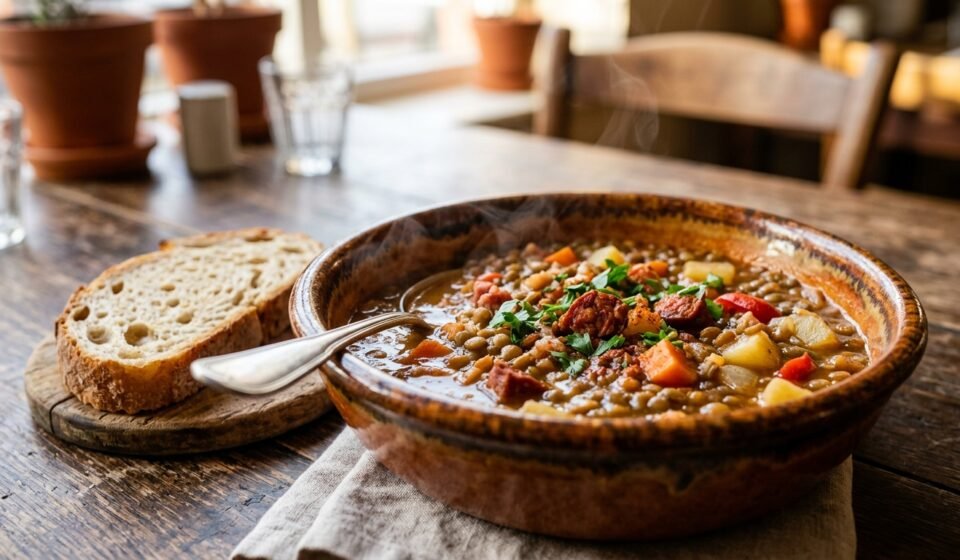

When cold weather arrives—or when you simply want something warm and satisfying—few dishes feel as comforting as a properly made lentil stew. Searching for best guiso de lentejas near me is usually less about finding the closest restaurant and more about finding a bowl that tastes homemade, has well-cooked lentils, and matches the style you actually enjoy.
The search can be surprisingly difficult because restaurants do not always use the same name. One menu may say guiso de lentejas, while another uses lentejas guisadas, lentejas caseras, or simply lentejas. The recipe can also vary considerably between Argentine, Spanish, and other Latin American kitchens. Current restaurant menus show everything from traditional meat-based preparations to clearly labeled vegan versions.
That means a smart search needs more than a restaurant’s star rating. You need to know what to look for, how to check whether the dish is currently available, and which details can reveal whether the bowl is likely to be worth ordering.
What Is Guiso de Lentejas?
Guiso de lentejas is a hearty lentil stew built around cooked lentils and a flavorful base of vegetables, seasonings, and, depending on the recipe, meat or cured products. It is particularly associated with Spanish and Latin American home-style cooking, although there is no single universal recipe.
An official Buenos Aires City recipe demonstrates just how flexible the dish can be. Its vegetable-focused version uses lentils with leek, tomatoes, cumin, turmeric, coriander, ginger, pepper, and cinnamon, showing that not every guiso needs meat to have a distinctive character.
An Argentine community recipe published by Rosario’s municipal government takes a more substantial approach, using lentils, onion, garlic, pepper, carrots, chorizo, pancetta, tomato, bay leaf, broth, paprika, and oregano. It also provides a vegetarian variation without the chorizo and pancetta.
This variety is important when searching locally. The phrase “guiso de lentejas” tells you the general dish, but not necessarily exactly what will arrive at the table.
Why Finding the Best One Takes More Than a Map Search
The first result on a restaurant app is not automatically the best choice.
Recent search-result competitors largely agree on one useful point: checking the actual menu, recent customer photos, reviews that specifically mention the dish, and daily specials can be more informative than relying on the restaurant’s overall rating alone.
That is particularly relevant for guiso de lentejas because restaurants may prepare it as a rotating or seasonal item rather than as a permanent menu staple.
A restaurant can have excellent reviews for steaks, empanadas, tapas, or sandwiches and still offer a mediocre lentil stew. Conversely, a modest neighborhood restaurant might have exactly the kind of slow-cooked dish you’re hoping to find.
The better approach is to judge the dish itself rather than the restaurant’s reputation in isolation.
Where to Look for Guiso de Lentejas Near You
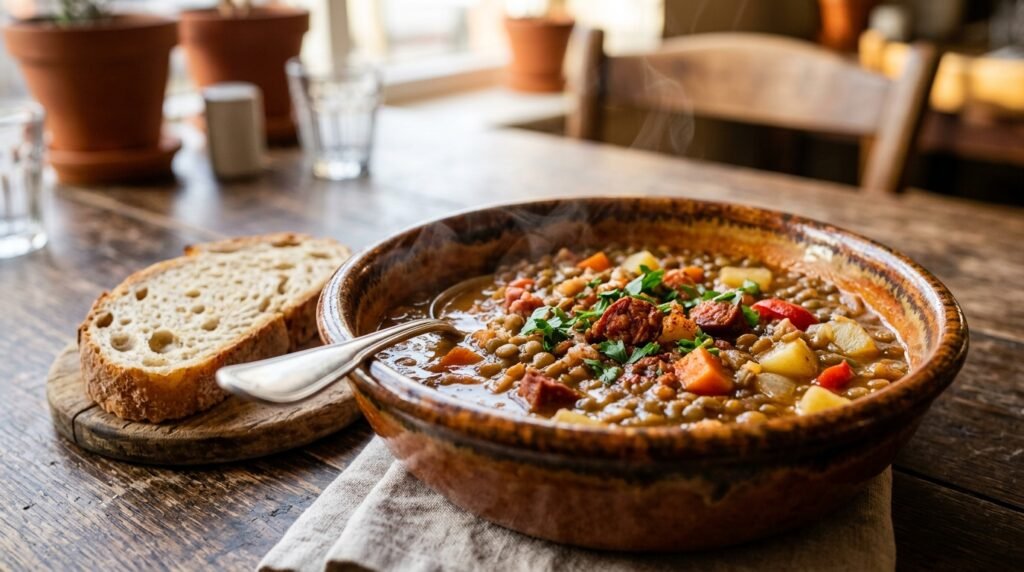
Argentine restaurants are an obvious place to start, especially establishments focused on traditional or home-style cooking. Current Argentine menus demonstrate that lentil stew remains part of the broader traditional comfort-food category. For example, Sol del Nahuel in Bariloche currently lists guiso de lentejas among its typical Argentine dishes, while another Argentine menu describes lentejas de la Cordillera as a lentil stew made with meats, pancetta, and Spanish-style cured sausage.
Spanish restaurants are another strong option. Their version may appear under names such as lentejas con chorizo or another regional description rather than the exact phrase you typed into a search engine. Ibericus, for instance, currently lists lentils cooked with chorizo, onion, garlic, and spices.
Vegetarian and vegan restaurants are also worth checking. A current Bariloche delivery listing shows a vegan guiso made with lentils, onion, garlic, bell pepper, and carrot.
This creates an important search opportunity: don’t stop after searching one phrase.
Try combinations such as “guiso de lentejas,” “lentejas guisadas,” “lentejas con chorizo,” “Argentine lentil stew,” “Spanish lentils,” or “vegan lentil stew” with your neighborhood or city.
How to Tell Whether a Restaurant’s Guiso Is Worth Trying
Once you’ve found a few nearby options, pay attention to the description.
Good guiso de lentejas should generally have tender lentils and a flavorful, cohesive cooking liquid. The texture can range from brothy to thick and spoon-coating, so there is no single correct consistency. What matters is that the dish tastes developed rather than watery or under-seasoned.
Vegetables should contribute flavor and texture rather than appearing as an afterthought. Depending on the regional recipe, you may encounter carrots, potatoes, onions, peppers, tomatoes, leek, garlic, or other ingredients.
Seasoning is equally important. Argentine recipes may include paprika and oregano, while other versions can feature cumin, bay leaf, smoked paprika, or different aromatic combinations. The official Buenos Aires recipe, for example, uses a notably different spice profile from the more traditional chorizo-and-pancetta version documented by Rosario’s municipal recipe collection.
The key lesson is that authenticity does not mean every bowl must taste identical.
Check Recent Reviews Instead of Only the Star Rating
Reviews become much more useful when you search for the dish itself.
Look for recent comments mentioning phrases such as “lentils,” “guiso,” “lentejas,” “chorizo,” “homemade,” “portion,” “flavor,” or “daily special.” A review written months or years ago may describe a recipe that has since changed.
Customer photographs can also reveal useful details that menu descriptions leave out. You may be able to see whether the stew is thick or soupy, whether it contains visible sausage or meat, how large the serving is, and whether the restaurant serves it with bread or another accompaniment.
Still, photos should be treated as evidence rather than proof. Menus change, dishes vary by day, and an old photograph may no longer represent the current preparation.
Ask Whether It Is Available Today
This is one of the easiest ways to avoid a wasted trip.
Many restaurants rotate traditional dishes, especially stews. A listing online does not always guarantee that the kitchen is serving it today.
If the restaurant is Spanish-speaking, a simple question such as “¿Tienen lentejas hoy?” means “Do you have lentils today?” You can also ask “¿Las lentejas llevan carne?” if you need to know whether the preparation contains meat. These practical questions are especially useful when menu information is incomplete.
For delivery, check the current ordering page rather than relying on a search snippet or an old social-media post.
Meat, Chorizo, or Vegetarian?
This is one of the biggest differences between local versions.
Some guisos are built around chorizo, pancetta, beef, pork, or meat stock. Others are completely vegetarian or vegan. The important point is not to assume that a stew described as “vegetable” is automatically vegetarian.
Current menus show the full range. Hosteria Hua Hum lists both a standard lentil stew with chorizo, pancetta, potato, sweet potato, and carrots and a separate vegetarian version cooked without meat.
A vegan restaurant in Bariloche likewise offers a version based on lentils, onion, garlic, bell pepper, and carrot.
For anyone avoiding animal ingredients, asking about the stock is just as important as asking about the visible ingredients.
Is Guiso de Lentejas Nutritious?
Lentils themselves are nutrient-dense legumes. Harvard’s Nutrition Source identifies lentils as sources of protein, fiber, folate, iron, potassium, and manganese. It also notes that one cup of cooked lentils provides about 18 grams of protein and 15 grams of fiber.
However, the nutritional profile of restaurant guiso de lentejas depends heavily on the complete recipe.
A vegetable-based stew may have a very different profile from one containing generous amounts of chorizo, pancetta, or other cured meats. Portion size, added oil, salt, toppings, and accompaniments also matter.
So it is more accurate to think of guiso as a flexible dish rather than automatically labeling every version “healthy” or “unhealthy.”
Restaurant or Delivery?
Guiso de lentejas can work particularly well for takeaway because it is a stew rather than a dish that depends on crisp textures surviving transport. Even so, packaging and serving conditions can affect the final experience.
For a first visit, eating at the restaurant can give you a clearer impression of the dish’s portion, texture, aroma, and presentation. Once you know you like a particular kitchen’s version, delivery becomes much easier.
When ordering delivery, check whether the restaurant has recent reviews specifically about the stew. Also pay attention to descriptions indicating whether the dish is freshly prepared, frozen, or part of a rotating meal service. Current menus show that some establishments sell guiso as a prepared or frozen item rather than as a made-to-order entrée.
What to Eat With Guiso de Lentejas
The answer depends on the style and how substantial the stew already is.
Bread is a natural pairing for a rich bowl, particularly when there is plenty of flavorful cooking liquid. Some versions may also be served with rice or another simple accompaniment. The Buenos Aires government’s lentil recipe specifically suggests serving its vegetable version with cooked vegetables or rice.
You do not necessarily need a large side dish, though. A well-made guiso can be filling enough to stand on its own.
For heavier Argentine versions containing sausage and pork, a simple accompaniment may be preferable. For a lighter vegetarian version, rice, bread, or a small salad can provide a more complete meal.
A Better Way to Choose Between Nearby Restaurants
Suppose your search produces five restaurants within a few miles. Instead of automatically choosing the closest one, compare them on four practical questions.
First, does the current menu actually list the dish?
Second, do recent reviews specifically mention the guiso or lentils?
Third, does the restaurant clearly explain the ingredients and whether meat is included?
Fourth, does the dish appear to be a regular specialty, seasonal item, or occasional daily special?
This process is more useful than treating distance as the only deciding factor.
A restaurant that is slightly farther away but currently serves a well-reviewed, clearly described guiso may be a much better choice than a nearby establishment whose listing has not been updated.
What If Your Search Finds Nothing?
Don’t assume there is no guiso available.
The problem may simply be the wording.
Search for “lentejas,” “lentejas guisadas,” “lentejas caseras,” “lentejas con chorizo,” “Spanish lentils,” or “Argentine lentil stew.” Current menus demonstrate why this matters: one restaurant may call the dish guiso de lentejas, another lentejas con chorizo, and another may use a distinctive regional name.
You can also search specifically for traditional restaurants, Spanish restaurants, Argentine restaurants, neighborhood bodegones, or vegetarian kitchens.
That broader approach can reveal dishes that a strict exact-keyword search would miss.
Frequently Asked Questions
What does guiso de lentejas mean?
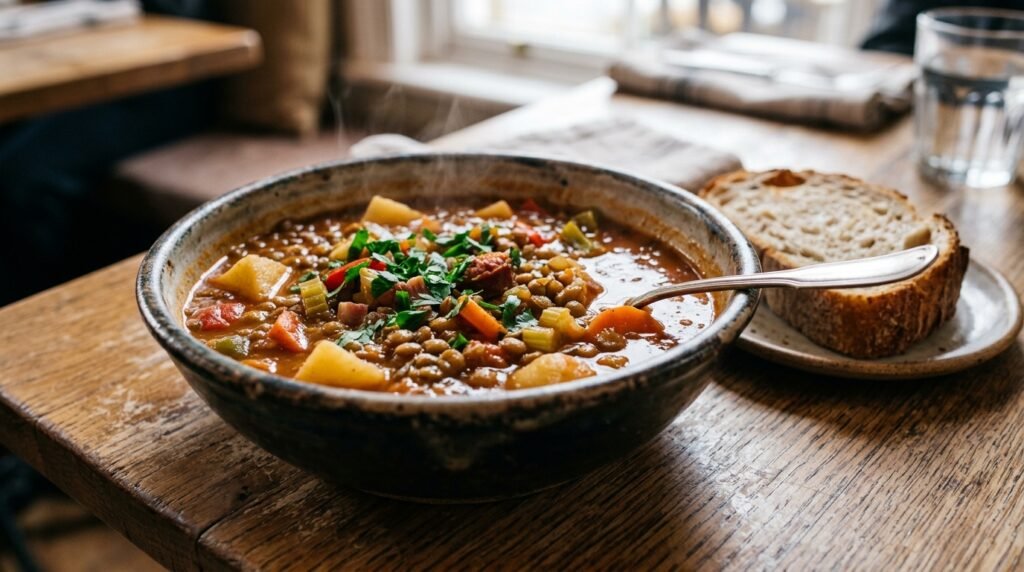
“Guiso de lentejas” translates roughly to “lentil stew.” It generally refers to a hearty preparation of lentils cooked with vegetables and seasonings, with meat or cured products included in some versions.
Is guiso de lentejas the same as lentil soup?
Not necessarily. Both contain lentils, but guiso usually suggests a more substantial stew-like preparation. Texture varies by recipe, so the distinction is not absolute.
Does guiso de lentejas always contain chorizo?
No. Some traditional versions contain chorizo, pancetta, pork, beef, or other meat, while vegetarian and vegan versions are also available.
How do I find the best guiso de lentejas near me?
Start with current local restaurant listings, then check the menu, recent reviews, customer photos, and daily specials. Search alternative names such as lentejas guisadas or lentejas con chorizo as well.
Is guiso de lentejas a healthy meal?
It can be a nutritious option because lentils provide protein and fiber along with several micronutrients. The overall nutritional profile depends on the recipe, especially the amount of cured meat, oil, salt, and other additions.
Can I find vegan guiso de lentejas?
Yes. Current restaurant listings show vegan versions made without meat, including preparations based on lentils and vegetables.
Final Thoughts
Finding the best guiso de lentejas near me is really a matter of knowing what you are searching for.
The closest restaurant may not serve the dish today, and the most highly rated restaurant in your area may not specialize in traditional stews. A better strategy is to look for current menus, recent dish-specific reviews, customer photographs, and clear ingredient information.
Most importantly, remember that guiso de lentejas has no single fixed identity. A chorizo-rich Argentine version, a Spanish lentil dish, and a vegetable-based vegan stew can all offer completely different experiences while still belonging to the same family of comforting lentil dishes. Official recipes and current restaurant menus demonstrate just how broad that spectrum can be.
When your search results seem disappointing, broaden the wording rather than giving up. The bowl you are looking for may already be nearby—it may simply be listed under a different name.