



When the heater or air conditioner is working but hardly any air comes from the dashboard vents, the problem may be hiding in a small but essential component: the blower motor. This electric motor drives the cabin fan that moves air through the vehicle’s HVAC system and sends it toward the occupants.
Unlike the A/C compressor, the blower motor does not create the cooling effect itself. Instead, it provides the airflow needed to carry cooled or heated air into the cabin. It also plays an important role in windshield defogging and defrosting.
This guide explains what a car blower motor does, where it is located, how it works, the warning signs of failure, how it differs from a blower motor resistor or control module, and what replacement may cost.
What Is a Blower Motor?
A blower motor is an electric motor connected to a fan or blower wheel inside a vehicle’s heating, ventilation, and air conditioning system. When you select a fan speed, the HVAC system controls the blower so it moves the required amount of air through the ducts.
The air can be routed across the heater core when heat is requested or across the A/C evaporator when cooling is needed. The blower then pushes that conditioned air toward the appropriate vents.
The basic idea is simple: the HVAC system conditions the air, while the blower motor provides the force that actually moves it.
This is why a vehicle may have a fully functioning A/C compressor and still produce almost no airflow from the vents. The refrigerant system can be working correctly while the blower circuit has a problem.
What Does a Blower Motor Do?
The main job of the blower motor is to circulate air through the cabin HVAC system.
When you turn the fan on, electrical power reaches the blower circuit. The motor spins its fan wheel, pulling air into the HVAC housing and pushing it through the heater core, evaporator, or other portions of the air-distribution system before the air exits through the selected vents.
The blower supports several everyday functions:
Heating depends on airflow through the heater core so warm air can enter the cabin.
Air conditioning depends on airflow across the evaporator so cooled air can be delivered through the vents.
Ventilation uses the same basic blower function to circulate fresh or recirculated cabin air.
Defrosting and defogging also rely on strong airflow directed toward the windshield. A weak or failed blower can therefore make it harder to clear condensation or frost from the glass.
The blower motor is also separate from the engine cooling fan. The cabin blower is generally associated with the HVAC housing inside or near the passenger compartment, while the radiator or cooling fan operates at the front of the vehicle to help control engine temperature.
Where Is the Blower Motor Located?
In many vehicles, the blower motor is located under the dashboard on the passenger side, often near or below the glove box. However, its exact position depends on the vehicle’s design.
Some applications place the blower assembly in another part of the HVAC housing or provide access from the engine compartment. Cars with front and rear climate systems can also have more than one blower motor.
Before removing anything, the vehicle-specific service information should be checked. CarParts.com also recommends disconnecting the battery before accessing the component, while noting that access can vary considerably between vehicles.
This variation is important for DIY repairs. A blower motor that is easy to reach on one car may require significantly more interior disassembly on another.
How Does a Blower Motor Work?
A traditional automotive blower circuit may include a fuse, relay, fan switch or climate-control electronics, blower motor resistor, electrical wiring, and the motor itself.
On older or simpler systems, fan speeds are commonly changed through a resistor that reduces the electrical input for lower speeds. The highest speed often uses a more direct power path, which is why a failed resistor can leave the fan operating only at maximum speed.
Newer vehicles can use electronic blower control modules instead. For example, GM describes its genuine HVAC blower control modules as microprocessor-based components that receive input from the HVAC control system and modulate blower speed.
That means the same symptom does not always point to the same failed component. Vehicle design matters.
Modern automotive HVAC development also focuses on airflow efficiency. DENSO, for example, describes newer blower structures designed to optimize airflow while reducing system size and power consumption.
Common Symptoms of a Bad Blower Motor
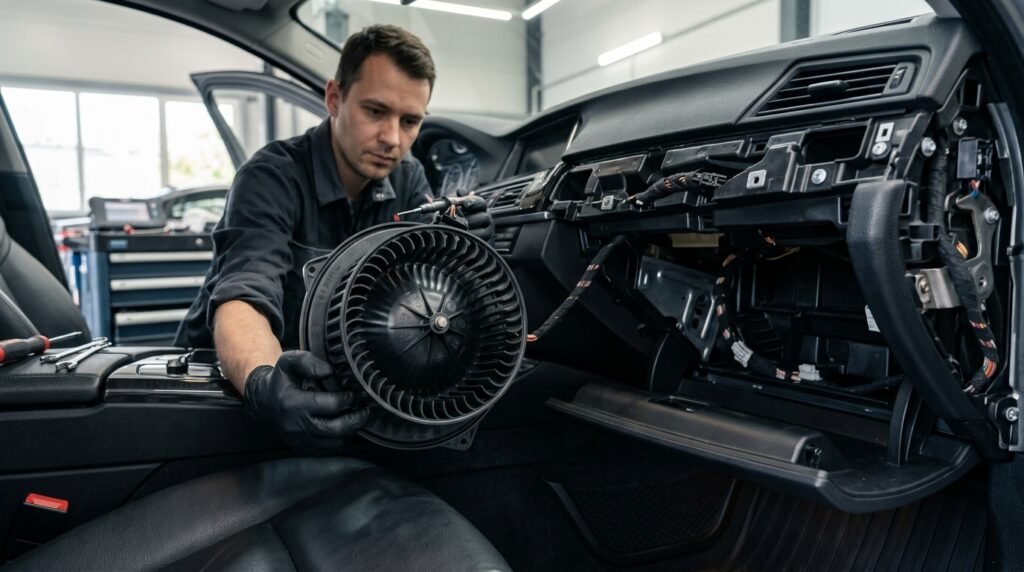
A failing blower motor does not always stop suddenly. It can develop symptoms gradually, giving you clues before complete failure.
Weak Airflow
One of the most common warning signs is weak airflow even when the fan is set to a high speed. A worn motor may no longer produce the airflow it once did.
Weak airflow can also have other causes, including a restricted cabin air filter, debris inside the blower wheel, HVAC doors, or other airflow restrictions. For that reason, weak airflow by itself does not prove that the motor is defective.
No Airflow at Any Speed
If the HVAC controls appear to work but absolutely no air comes from the vents, the blower motor could have failed.
However, technicians generally check the electrical supply before condemning the motor. A blown fuse, failed relay, damaged connector, wiring problem, control module, or fan switch can also interrupt blower operation.
Strange Whirring, Rattling, or Squealing
Unusual noises are another important clue.
A blower wheel can become unbalanced if leaves or other debris enter the housing. Worn bearings or other internal motor problems can also create whirring, squealing, rattling, or vibration.
A noise that changes as you increase or decrease fan speed is especially useful information during diagnosis because the blower assembly is directly involved.
Fan Works Intermittently
A blower that works sometimes and then suddenly stops can indicate a motor, electrical connection, relay, control, or switch problem.
Intermittent operation should not automatically be treated as proof of motor failure. A technician may need to test the circuit while the fault is present.
Burning Smell or Smoke
A burning smell coming from the vents deserves immediate attention.
A motor drawing excessive current, damaged wiring, a short circuit, or another electrical fault can generate heat. NAPA and RepairPal both advise shutting the HVAC system off when smoke or a burning smell appears and having the problem investigated rather than continuing to operate the system.
Blower Motor vs. Blower Motor Resistor
This is one of the most important distinctions when diagnosing a fan problem.
The blower motor creates the airflow. The resistor, in systems that use one, helps control the motor’s speed.
A classic resistor failure is a fan that works on the highest setting but not on lower settings. That’s because many traditional systems bypass the resistor at maximum speed, allowing full power to reach the motor.
If the fan does not work at any speed, the diagnosis becomes broader. The problem could involve the motor, fuse, relay, wiring, ground, switch, resistor, electronic control module, or another HVAC component.
Replacing the most obvious part without testing can therefore waste money.
Why Does a Blower Motor Fail?
Blower motors are exposed to mechanical wear, electrical loads, heat, and contamination over time.
One common issue is debris entering the blower housing. Leaves, dirt, or other foreign material can interfere with the fan wheel, create vibration, and affect motor operation. A Hyundai technical service bulletin specifically warns that debris entering the blower unit during cabin-filter service can cause improper operation or abnormal noise.
Worn bearings or other internal components can also make the motor operate less efficiently. In some cases, an aging motor can draw excessive current and contribute to repeated failure of the blower resistor, control module, connector, or related wiring. Standard Motor Products advises checking blower motor current draw and inspecting connectors for heat damage when diagnosing these failures.
A missing or neglected cabin air filter can allow more contaminants to enter the blower area. Filter maintenance therefore has value beyond simply improving cabin air cleanliness.
How to Diagnose a Blower Motor Problem
The first step is to confirm the actual symptom. Does the blower work on high only? Does it work intermittently? Is airflow weak at every speed? Does the motor make a noise?
Next, basic electrical checks can narrow down the cause.
Check the vehicle’s blower-related fuse according to the owner’s manual. Do not assume that every car uses the same fuse location or rating. Ford owner’s manuals, for example, show blower motors protected by vehicle-specific fuses and relays, demonstrating why the correct manual matters.
If the fuse is good, the electrical connector and power supply can be checked. RepairPal notes that technicians may inspect the connector to determine whether power is reaching the motor.
For more advanced diagnosis, a technician can test the blower circuit, control device, motor operation, and current draw against vehicle-specific specifications. A multimeter or appropriate current-measuring equipment may be required, but exact test procedures vary by vehicle.
The important rule is simple: test before replacing parts.
Can You Drive With a Bad Blower Motor?
A failed blower motor usually does not prevent the engine from running or the vehicle from moving, but that does not make the problem harmless in every situation.
The most important issue is windshield visibility. If the blower cannot provide the airflow needed to defog or defrost the windshield, visibility can deteriorate in rain, cold weather, or humid conditions. RepairPal identifies ineffective defrosting as the main safety-related concern associated with a failed heater blower.
Smoke or a burning electrical odor is a different matter. In that situation, shut the HVAC system off and stop driving when it is safe to do so until the source has been inspected.
How Much Does Blower Motor Replacement Cost?
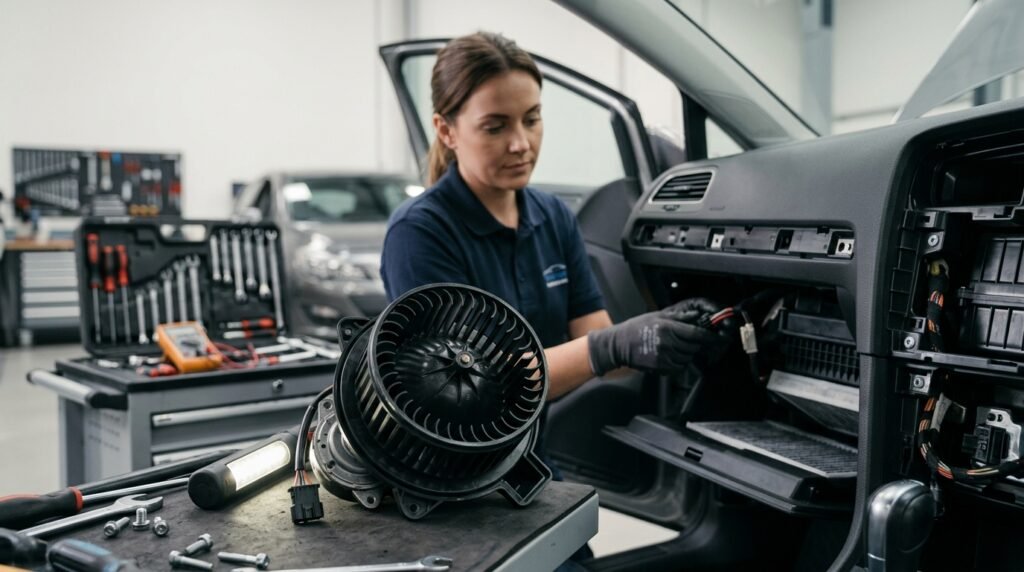
The cost depends heavily on the vehicle, part quality, labor time, and whether additional components have failed.
As of September 3, 2026, RepairPal lists an average U.S. blower motor replacement estimate of $383 to $435, including estimated labor of $94 to $138 and parts of $288 to $297. The service notes that taxes, fees, location, and related repairs can affect the final price.
Another useful reference is CarParts.com, which says a replacement blower motor itself generally costs about $50 to $200, with labor commonly ranging from $100 to $500, depending on the vehicle.
These figures are not contradictory. A part-only price is different from a complete professional repair estimate, and different vehicles can require very different parts and labor.
The most accurate estimate comes from identifying the exact year, make, model, engine, HVAC configuration, and failed component.
Should You Replace the Blower Motor Yourself?
Some blower motors are relatively accessible and can be removed with basic hand tools. Others are much harder to reach.
A passenger-side under-dash location can make the repair straightforward on some vehicles, while other designs may require removing trim panels or additional components.
DIY replacement becomes more complicated when the original problem has not been diagnosed. Installing a new motor will not fix a blown fuse, failed resistor, damaged wiring, or bad control module.
Electrical diagnosis also requires care. Anyone without experience working around automotive electrical circuits may be better served by professional diagnosis, particularly when there is a burning smell, melted wiring, repeated fuse failure, or evidence of overheating.
How to Help Prevent Blower Motor Problems
There is no maintenance schedule that guarantees a blower motor will never fail, but several habits can reduce avoidable problems.
Keep the cabin air filter replaced according to the vehicle manufacturer’s recommended interval and operating conditions. During filter replacement, take care not to drop leaves or other debris into the blower housing.
Pay attention to new rattling, squealing, vibration, intermittent operation, or reduced airflow. Catching a problem early can help prevent a worn motor from creating additional electrical damage.
It is also worth investigating repeated resistor or control-module failures instead of simply replacing the same component again. Excessive motor current or damaged connectors can be part of the underlying problem.
Frequently Asked Questions About Blower Motors
Is the blower motor the same as the A/C compressor?
No. The compressor circulates and pressurizes refrigerant in the A/C system, while the blower motor moves cabin air across the evaporator or heater core and through the vents.
Why does my blower only work on high?
On many vehicles, the lower speeds pass through a resistor or electronic speed-control device, while maximum speed uses a different electrical path. A failed resistor is therefore a common explanation for a blower that works only on high.
Does a bad blower motor affect heating and cooling?
Yes. The heating or refrigeration components may still function, but without sufficient blower airflow, conditioned air cannot be properly delivered through the cabin vents.
Where should I look for the blower motor?
In many cars, it is under the dashboard on the passenger side near the glove box, but the exact location varies by vehicle. Always consult the vehicle-specific manual or service information before removing parts.
What is the most obvious sign of a failing blower motor?
Weak or missing airflow, especially when accompanied by unusual noise or vibration, is one of the strongest clues. However, those symptoms can also result from other HVAC or electrical problems, so proper diagnosis is important.
Conclusion
The blower motor is easy to overlook because it works quietly in the background, but it is central to a vehicle’s HVAC airflow. It moves air through the heating and cooling system, supports ventilation, and helps the defroster clear the windshield.
Weak airflow, unusual noises, intermittent operation, a fan that works only on certain speeds, and complete loss of airflow can all point toward a problem. However, not every blower symptom means the motor itself has failed. Fuses, relays, resistors, control modules, wiring, connectors, filters, and debris can create similar complaints.
A careful diagnosis is therefore more valuable than immediately buying a replacement motor. When the actual cause is identified first, the repair is more likely to solve the problem instead of simply replacing one part while another fault remains.



Comments are closed.
[…] Blower Motor: How It Works, Symptoms, Testing, and Replacement Cost […]