

Learning Spanish becomes much more interesting when you move beyond textbook vocabulary and start noticing the expressions people actually use in everyday conversations. That is especially true with Mexican Spanish, where familiar Spanish words can take on local meanings, while slang and regional expressions add another layer to communication.
The idea behind a Mexican word of the day is simple: learn one useful word or expression regularly, understand its meaning, see how it works in a sentence, and then use it in context. This approach can make vocabulary easier to remember than trying to memorize dozens of disconnected words at once.
One important point is that there is no single official institution that publishes one universally recognized “Mexican word of the day.” Instead, the phrase generally refers to a daily learning format focused on Mexican Spanish vocabulary, expressions, and cultural usage. The Academia Mexicana de la Lengua maintains consultation resources and dictionaries for Mexicanisms, while ASALE’s Diccionario de americanismos documents vocabulary and meanings associated with Mexico and other Spanish-speaking regions.
Today’s Mexican Word: Órale
A great word to begin with is órale.
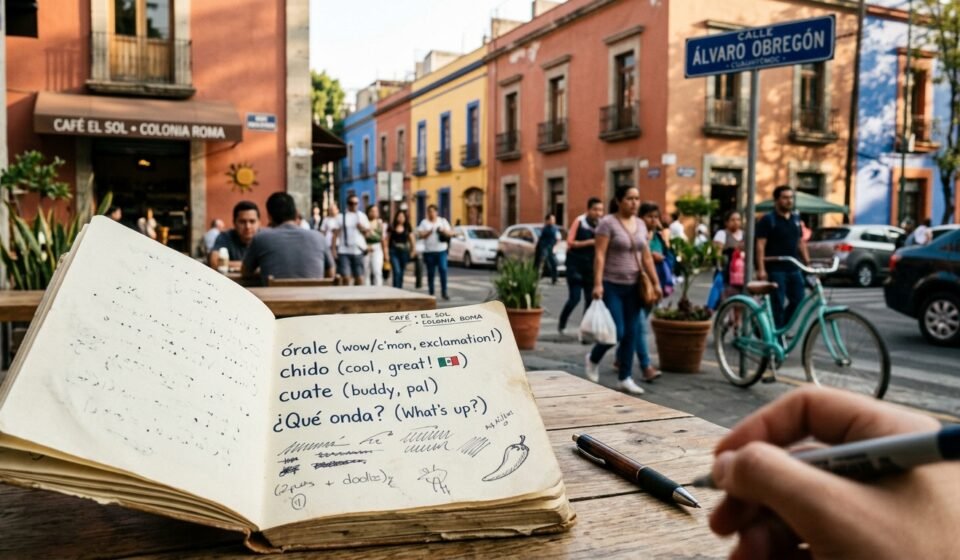
ASALE’s Diccionario de americanismos records ¡órale! in Mexico as an interjection that can express agreement or acceptance, encouragement to do something, and surprise or astonishment. That range explains why English translations vary according to context.
Depending on the situation, órale can communicate ideas such as:
- “Okay.”
- “All right.”
- “Come on.”
- “Let’s go.”
- “Wow!”
For example:
“¿Vamos al centro?”
“¡Órale!”
Here, the expression can work much like “Sure!” or “Let’s go!”
In another situation, a surprised speaker might say:
“¡Órale! ¿Ya terminaste?”
The meaning is closer to “Wow! You already finished?”
The key lesson is that Mexican Spanish cannot always be understood through one-to-one translation. Tone, situation, and the relationship between speakers matter.
Why Mexican Spanish Has Its Own Vocabulary
Mexican Spanish is part of the broader Spanish language, but regional varieties naturally develop their own vocabulary and expressions. Academic research on Spanish in Mexico has documented substantial regional variation, including differences influenced by local indigenous languages.
Nahuatl has had a particularly important influence on Mexican vocabulary. Words associated with Mexico, including tomate, chocolate, and aguacate, have histories connected to Nahuatl, while many other Mexican expressions developed through centuries of contact between Spanish and Indigenous languages.
This is one reason a learner can know standard Spanish and still encounter unfamiliar words in Mexico.
There is another important distinction: not every word commonly heard in Mexico is exclusive to Mexico. Some expressions are used elsewhere in Latin America as well. ASALE’s dictionary is useful because it identifies the geographical areas associated with particular meanings rather than simply labeling every colloquial word “Mexican.”
Güey: One of the Most Recognizable Mexican Expressions
Few words demonstrate the flexibility of Mexican Spanish better than güey, also commonly written informally as wey.
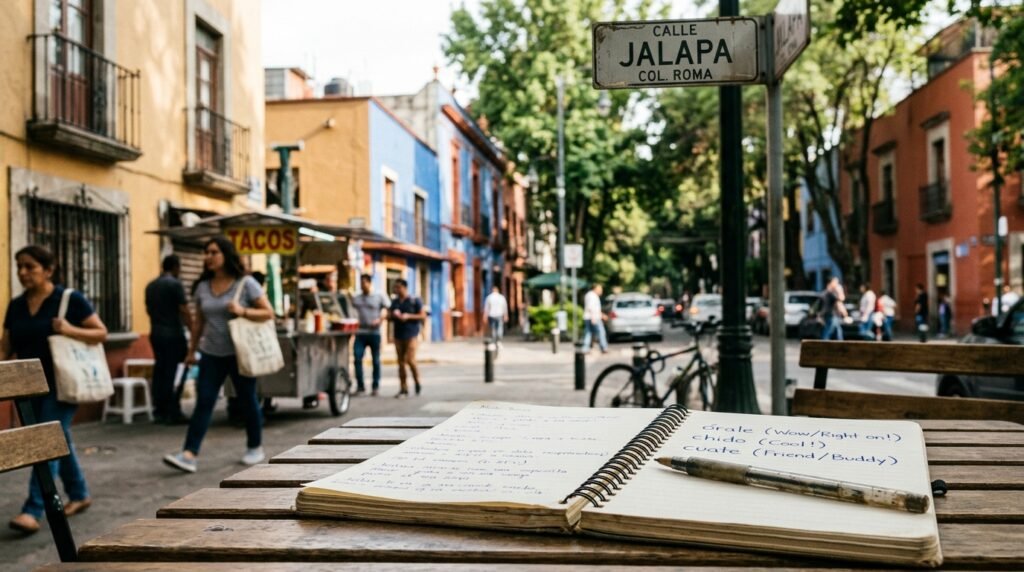
ASALE records several Mexican uses. It can refer to a foolish person, an intimate friend or companion, or an unspecified individual, depending on context.
The Academia Mexicana de la Lengua has also discussed the word’s development in detail. Its research notes that güey originated from buey and that its meaning changed considerably over time. A word that had strongly negative associations in earlier usage gradually developed more neutral and even friendly uses among later generations.
That makes güey an excellent reminder that vocabulary is not static.
A learner might encounter:
“¿Qué onda, güey?”
In a friendly setting, this can be understood roughly as “What’s up, dude?”
However, learners should not automatically use güey with everyone. It is highly informal, and using casual slang with strangers, elders, or in professional situations can sound inappropriate.
Chido Means Cool
Another useful Mexican word of the day is chido.
ASALE defines chido in Mexican usage as meaning attractive, nice, or very good.
For example:
“Está muy chido ese lugar.”
A natural English interpretation would be:
“That place is really cool.”
The feminine form is chida, so you may hear both chido and chida depending on the noun being described.
This word is especially useful because it helps learners sound more natural without requiring offensive or vulgar slang.
Neta: Talking About the Truth
Neta is another expression strongly associated with Mexican Spanish.
ASALE records neta in Mexican usage with the meaning of truth or genuineness. It can appear as a noun and in familiar expressions.
Consider:
“La neta, no sé.”
This can be understood as:
“Honestly, I don’t know.”
You may also hear:
“¿Neta?”
Depending on tone, that can mean “Really?” or “Seriously?”
Words like neta show why context is so important. A dictionary gives the core meaning, but a real conversation reveals how speakers use the word emotionally and socially.
Cuate: A Friendly Mexican Word
Cuate is particularly interesting because ASALE traces it to Nahuatl coatl. In Mexican usage, it can refer to a person, a close friend or companion, or someone considered trustworthy. It can also have other meanings in Mexico, including “twin” or something that forms a pair.
In an everyday conversation:
“Es mi cuate.”
could mean:
“He’s my buddy.”
This is the kind of vocabulary that helps learners understand Mexican culture as well as language because it reflects relationships and informal social interaction.
Ahorita Is More Complicated Than It Looks
One of the best examples of contextual Mexican Spanish is ahorita.
ASALE records ahorita in Mexico and several other Spanish-speaking areas with the meaning of “within a moment” or “later,” while related forms can have slightly different interpretations depending on region.
For a learner, the important takeaway is that ahorita should not always be treated as a precise clock-based word.
Someone saying:
“Ahorita regreso.”
may be communicating that they will return soon, but the exact amount of time is not necessarily specified by the word itself.
This is a good example of why literal translation alone can be misleading.
Chavo and Chamaco for Young People
Mexican Spanish has several familiar ways to refer to younger people.
ASALE records chavo and chava in Mexico for young people and, in some uses, for children or romantic partners.
Chamaco and chamaca can refer to a boy, girl, child, or teenager in Mexican usage. ASALE also identifies chamaco as a word with Nahuatl origin and records a Mexican use referring to a son or daughter.
For learners, these distinctions are useful because English translations such as “kid,” “boy,” “girl,” or “young person” may not capture every possible context.
Padre Does Not Always Mean Father
One of the easiest mistakes for Spanish learners is assuming that every familiar word keeps exactly the same meaning in casual Mexican speech.
Padre is a good example.
In standard Spanish, padre commonly means “father.” But ASALE also records a Mexican colloquial use meaning nice, good, excellent, or very good.
So:
“¡Qué padre!”
can mean something like:
“How cool!”
rather than “What father!”
This is precisely the kind of vocabulary that makes a Mexican word-of-the-day approach useful. Learning the word together with a natural example is much more effective than memorizing an isolated dictionary definition.
Chamba: A Common Word for Work
Chamba is another useful term to add to a Mexican Spanish vocabulary routine. ASALE records it in Mexican usage for the activity a person regularly performs to earn a living and, in Mexico, also for unstable employment.
A learner might encounter:
“Tengo mucha chamba hoy.”
The general idea is:
“I have a lot of work today.”
This word also illustrates an important research lesson: some words widely perceived as “Mexican” are actually used across several countries. A reliable dictionary can show where a word is documented rather than relying on assumptions.
Mexican Slang Should Be Learned With Context
Many online guides focus heavily on slang. Competitor resources commonly explain popular terms such as güey, chido, qué onda, órale, and other informal expressions.
That information is useful, but a stronger learning method is to divide vocabulary into categories.
Start with everyday, low-risk expressions such as chido, cuate, neta, and órale. Once you understand those, move into more regional or informal vocabulary.
Vulgar slang requires additional care. Some Mexican expressions can be offensive, highly informal, or inappropriate in professional and unfamiliar settings. A learner’s goal should be understanding first, not immediately copying every expression heard in movies, social media, music, or conversations. Mexican Spanish learning resources also warn learners to consider audience and context when dealing with vulgar language.
How to Build Your Own Mexican Word of the Day Routine
A simple daily routine can turn individual words into lasting vocabulary.
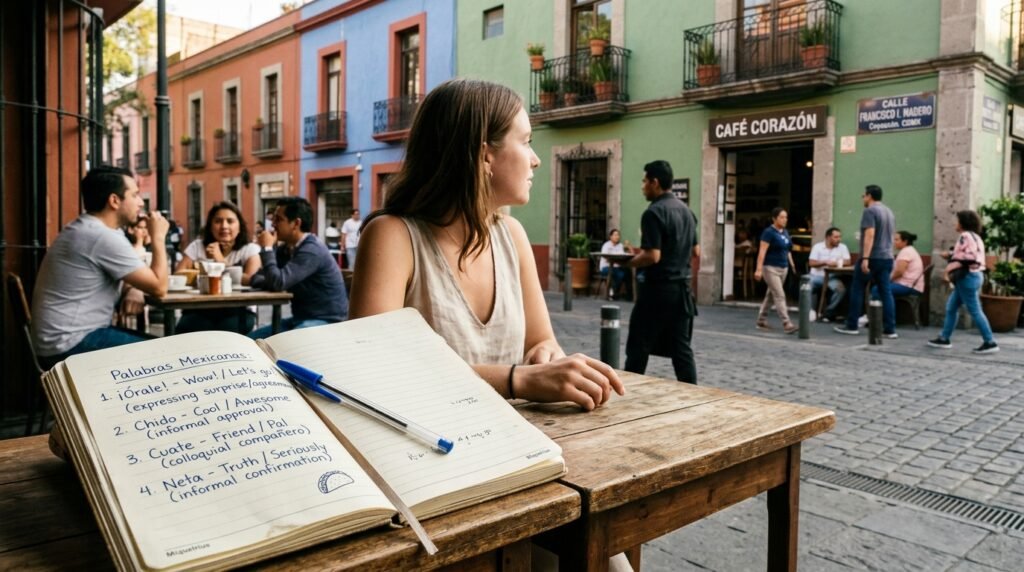
Choose one word each day. Write down its English meaning, pronunciation, part of speech, and one natural example sentence. Then look for another example in authentic Mexican Spanish.
The most important step is reviewing old words.
For example, a first week might look like this:
Day 1: órale — agreement, encouragement, or surprise.
Day 2: güey — informal “dude” or related Mexican uses.
Day 3: chido — cool or very good.
Day 4: neta — truth, honestly, or “really?”
Day 5: cuate — buddy or close friend.
Day 6: ahorita — shortly or later, depending on context.
Day 7: chamba — work or job.
The objective is not to memorize seven translations. It is to understand how seven words behave in actual conversation.
Common Mistakes Learners Should Avoid
The biggest mistake is assuming that Mexican Spanish is identical everywhere in Mexico. Mexico has significant regional linguistic variation, and vocabulary can differ between communities and regions. Academic work on Mexican Spanish specifically documents these regional differences.
Another mistake is using slang without understanding register. A word can be friendly among close friends but inappropriate with a stranger.
Literal translation is another trap. Expressions such as ¡órale! and ¡qué padre! demonstrate that a dictionary translation cannot always explain how a word functions naturally.
Finally, avoid treating internet slang lists as unquestionable authority. The ASALE dictionary and the Academia Mexicana de la Lengua provide much stronger reference points for understanding documented meanings and usage.
Why a Daily Vocabulary Approach Works
A Mexican word of the day works because it creates a manageable learning habit.
Instead of trying to master an enormous vocabulary list, you build knowledge through repeated exposure. More importantly, each word becomes connected to an example, a situation, and a cultural context.
Over time, these individual pieces begin to work together. A learner who understands órale, güey, chido, neta, cuate, and chamba is not simply memorizing six Spanish words. They are beginning to recognize the rhythm and social character of informal Mexican Spanish.
The best vocabulary learning is not about sounding Mexican overnight. It is about listening carefully, understanding context, and gradually recognizing how real speakers choose different words for different situations.
Frequently Asked Questions
What is a Mexican word of the day?
It is a daily vocabulary-learning format centered on Mexican Spanish. There is no single universally official daily word; learners and language resources can select a useful word or expression and study its meaning, pronunciation, examples, and cultural context.
What is a good Mexican word to learn first?
Órale is a strong starting point because it has several common uses. ASALE documents it in Mexico as expressing agreement, encouragement, and surprise.
What does güey mean in Mexican Spanish?
Depending on context, güey can refer to a friend or companion, an individual, or a foolish person. Its meaning has changed significantly over time.
What does chido mean?
In Mexican Spanish, chido can mean nice, cool, or very good.
Is Mexican Spanish different from Spanish in Spain?
Yes. Spanish is a global language with substantial geographic variation in pronunciation, grammar, and vocabulary. Mexican Spanish has its own regional characteristics and vocabulary, including words influenced by Indigenous languages.
Final Thoughts
A good Mexican word of the day is more than a translation exercise. It is a small window into how people communicate in Mexico.
Words such as órale, güey, chido, neta, cuate, ahorita, chavo, and chamba demonstrate how meaning depends on context, relationships, region, and tone. Reliable dictionaries such as ASALE’s Diccionario de americanismos and resources from the Academia Mexicana de la Lengua can help learners separate documented Mexican usage from exaggerated or oversimplified internet lists.
The most effective strategy is simple: learn one useful word, understand how native speakers use it, practice it in a natural sentence, and then come back tomorrow for another one. With enough repetition, these individual words stop feeling like vocabulary exercises and start becoming part of real communication.